- All
- Product Name
- Product Keyword
- Product Model
- Product Summary
- Product Description
- Multi Field Search

Views: 0 Author: Site Editor Publish Time: 2026-11-02 Origin: Site
Warehouse operations eventually hit a critical inflection point where manual handling and standard selective racking become severe bottlenecks. Forklift travel times increase, labor availability fluctuates, and picking accuracy degrades under high volume. You need a more reliable method to move and track inventory. Automated Storage And Retrieval Systems(AS/RS) solve this exact problem. These systems go far beyond simple warehouse mechanization. They integrate software-driven logic with precise hardware movement for completely autonomous load management. Operations managers evaluate these systems to balance massive density requirements against the high cost of industrial square footage. By removing manual touches, you gain reliable operations, perfect inventory visibility, and high-speed retrieval capabilities. We will break down the engineering principles behind these systems, evaluate different architectures, and outline how to implement them successfully on the warehouse floor.
Density vs. Accessibility: Understand the fundamental trade-off between the ultra-high density of deep-lane shuttle systems and the high-selectivity requirements of crane-based AS/RS.
Software Dependency: Acknowledge that the hardware’s efficacy is entirely dependent on seamless Warehouse Management System (WMS) or Warehouse Execution System (WES) integration.
Lifecycle Costs: Look beyond capital expenditure (CapEx) to long-term operational expenses, focusing on predictive maintenance cycles, energy consumption profiles, and specialized spare parts logistics.
Scalability Constraints: Evaluate how initial footprint impacts future expansion; differentiate between modular shuttle systems and fixed-crane infrastructure.
An automated storage grid operates through three distinct but heavily integrated layers. The physical infrastructure includes the raw steel of the storage structure. It demands exact engineering tolerances to prevent mast deflection under heavy loads. Guidance systems use precision-milled floor rails anchored with high-strength epoxy grout, paired with top guide tracks to keep the machinery plumb. Transport mechanisms involve towering stacker cranes or fleet-based autonomous shuttles. They move heavy palletized loads rapidly across the grid, utilizing polyurethane drive wheels for smooth acceleration.
The control layer acts as the central nervous system. It relies on Programmable Logic Controllers (PLCs) mounted directly on the moving hardware. PLCs handle micro-second communication protocols over industrial networks like Profinet or EtherCAT. They track real-time inventory positioning within the grid using laser distance meters and optical encoders mounted on the drive axes. This closed-loop feedback prevents collisions, manages acceleration curves, and optimizes routing paths dynamically.
The integration layer connects the physical hardware to your host WMS. The WMS dictates overarching load sequencing based on outbound shipping schedules. It manages complex order fulfillment logic and ensures real-time inventory tracking across the entire facility. The WMS passes destination coordinates to a Warehouse Control System (WCS), which translates those coordinates into executable movement blocks for the PLCs. Without a robust integration layer, the physical hardware remains static.
The retrieval cycle follows a strict, sequential technical breakdown governed by physics and control logic. Command initiation starts at the WMS, which drops a task into the execution queue. The system calculates the optimal path based on the current crane position and the destination coordinates. X-Y-Z axis movement begins simultaneously to shave seconds off the cycle time. The crane accelerates down the aisle along the X-axis while the carriage lifts along the Y-axis. The control software applies specific deceleration curves to ensure the mast sway settles exactly as the crane arrives at the target slot.
Once positioned, the engagement phase begins. Telescopic forks or shuttle platforms extend into the rack location along the Z-axis. The load interface must be precise to millimeter tolerances to avoid striking the rack beams. The forks lift the pallet slightly, retract into the carriage, and secure the load. The unit then executes the return-to-base sequence. It navigates back to the front of the aisle and deposits the payload onto an outbound conveyor, a squaring station, or a pickup and delivery (P&D) stand.
Manual cycle counting disappears entirely in an automated environment. Integrated sensors scan barcodes, QR codes, or RFID tags the moment a load enters the system boundary. Profile scanners verify the load dimensions and weight on the inbound conveyor to ensure it fits the designated storage slot. If a pallet has shifting product, broken bottom boards, or exceeds the weight limit, the scanners flag it immediately.
The system automatically updates inventory levels in the WMS upon successful storage and retrieval. If a load is rejected due to overhang, the system routes it to a reject spur for manual intervention or repalletization. This strict gatekeeping eliminates manual cycle counting errors and prevents jammed machinery deep inside the grid. You maintain absolute inventory accuracy at all times, knowing exactly which pallet sits in which coordinate.
Automated Pallet Racking fits high-volume operations perfectly. It handles aggressive pallet-in and pallet-out workflows where you need massive stock keeping capacity combined with rapid throughput. This architecture utilizes stacker cranes operating in narrow aisles, typically only five to six feet wide. It delivers high selectivity, meaning the system can access any specific pallet without moving others out of the way. You deploy this setup in large-scale distribution centers managing thousands of unique SKUs with varying turnover rates. The cranes can reach heights exceeding 100 feet, maximizing the vertical cube of the building.
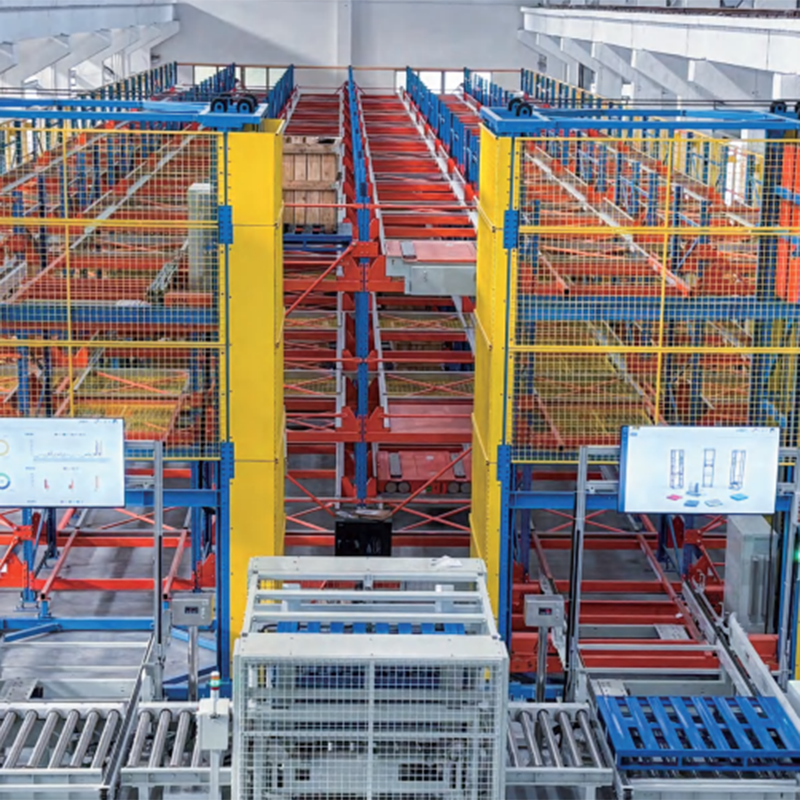
Automated Shuttle Racking provides exceptional high-density storage. It works best when SKU velocity is moderate but the volume per SKU is extremely high. You deploy these systems for specific sub-categories like beverage distribution, paper goods, or cold storage facilities. Shuttles drive deep into the racking lanes, sometimes up to 20 pallets deep, to deposit or retrieve loads. This eliminates the need for multiple crane aisles. You maximize space utilization in deep lanes, trading immediate selectivity for maximum storage density. The system manages inventory on a First-In-First-Out (FIFO) or Last-In-First-Out (LIFO) basis depending on the lane configuration.
You must determine whether to automate pallet-level movement or carton-level picking based on your outbound order profiles. Unit-load systems handle full pallets weighing up to 3,000 pounds or more. They require heavy-duty cranes, massive drive motors, and robust steel structures. Mini-load systems handle lightweight cartons, trays, or plastic totes weighing under 100 pounds. You choose based on product size and weight profiles. Heavy industrial goods and wholesale distribution require unit-load. E-commerce piece-picking, pharmaceutical distribution, and small parts manufacturing demand mini-load architectures equipped with specialized friction extractors.
High-Efficiency Automated Pallet Racking strategies focus strictly on maximizing throughput-per-aisle-foot. Multi-level shuttle deployments increase simultaneous movements across the grid. Instead of one crane serving an entire aisle, multiple shuttles operate on different vertical levels simultaneously. High-speed vertical lifts at the end of the aisle move pallets between the ground floor and the active shuttle levels. The system adapts dynamically to varying SKU profiles and seasonal volume spikes. Throughput scales linearly as you add more shuttles to the grid, preventing the single-crane bottleneck common in older designs.
System Architecture | Primary Advantage | Best Use Case | Selectivity Level |
|---|---|---|---|
Crane-Based Unit Load | High Speed & Access | High SKU count, mixed pallets | 100% Selectivity |
Deep-Lane Shuttle | Maximum Density | Low SKU count, high volume per SKU | Low (LIFO/FIFO dependent) |
Mini-Load System | High-Speed Piece Picking | E-commerce, small parts, totes | 100% Selectivity |
Multi-Level Shuttle | Scalable Throughput | High-velocity distribution centers | Moderate to High |
You must calculate cycles-per-hour (CPH) requirements based on hard historical data. Compare your current baseline against projected peak-season demand over the next five years. Do not rely on average daily volumes, as automated systems must handle your absolute peak hours without creating dock bottlenecks. Factor in system acceleration, top travel speed, and deceleration rates. Raw top speed matters less than consistent, repeatable cycle times. Analyze the dual-command cycle rate, which measures the system's ability to store one inbound pallet and retrieve one outbound pallet in a single continuous round trip. High dual-command efficiency drastically reduces empty travel time.
Calculate the density premium for your facility. Measure the exact square footage reclaimed by eliminating 12-foot wide forklift aisles and utilizing vertical building clearance up to the roof joists. Weigh this reclaimed space against the loss of operational flexibility. High density means strict tolerance limits. You can no longer store oversized, leaning, or irregularly shaped loads in the automated grid. Every pallet must conform to strict dimensional profiles. Assess the system-wide downtime risk. A denser grid often means harder access for maintenance personnel during a fault, requiring specialized harnesses and retrieval protocols.
Evaluate single points of failure rigorously before finalizing a layout. A broken stacker crane halts an entire aisle. Inventory in that aisle remains trapped until technicians conclude repairs. Redundant systems mitigate this risk significantly. Multi-shuttle arrays ensure that if one shuttle fails, it does not stop the entire row. Other shuttles can often be reassigned via the vertical lift to cover the workload. You must map out recovery protocols for trapped pallets, including manual override capabilities, emergency power supplies, and manual extraction tools.
High-density automated racks require strict compliance with local fire codes. Standard ceiling-mounted sprinklers cannot penetrate the dense storage grid. NFPA-compliant in-rack fire suppression is mandatory. You must route sprinkler pipes through the longitudinal and transverse flue spaces of the racking. Seismic bracing protocols ensure structural integrity in earthquake zones, often requiring heavier gauge steel and larger baseplates. Human-machine interface (HMI) safety zones are critical. You must implement physical perimeter fencing, optical light curtains, and strict lockout/tagout procedures to protect maintenance personnel from autonomous moving machinery.
Warehouse floor flatness dictates the success or failure of the entire installation. Standard concrete slabs poured for forklift traffic are entirely insufficient for automation. You must meet strict F-min numbers for flatness and levelness, often exceeding F-min 75. Uneven floors cause the crane mast to sway during travel. A quarter-inch variance at the floor plate translates to several inches of deflection at the top of a 100-foot mast. This deflection destroys crane bearings, causes load engagement failures, and triggers constant sensor faults. Structural slab integrity is equally critical. The slab must support massive point loads from the crane rails and the densely packed racking uprights. Engineers often require core drilling and soil bearing tests before approving a layout. Ceiling height constraints dictate your maximum vertical storage. You must coordinate the top guide rail installation with existing HVAC ducts, lighting fixtures, and ceiling-mounted fire suppression pipes.
Bridging legacy WMS platforms with modern automation hardware presents severe engineering challenges. API friction points cause major commissioning delays. Legacy systems often process data in batches, while automation requires real-time, millisecond-level communication. Middleware or a dedicated WCS is required to translate logical commands between the WMS and the PLCs. You must define the exact XML or JSON data payloads early in the project. Test software handshakes thoroughly in a simulated environment before going live on the floor. Do not underestimate the time required for software integration; it often takes longer than the physical steel erection.
Move entirely away from reactive, break-fix maintenance. Waiting for a component to fail causes unacceptable downtime in an automated facility. Implement data-driven predictive maintenance. Use vibration spectrum analysis on drive wheels to detect bearing wear before it seizes. Monitor thermal output on lift motors using infrared thermography to catch overheating issues during peak shifts. Sensor-based monitoring prevents catastrophic failures by alerting technicians to voltage drops or abnormal torque readings. Stock critical spare parts on-site in a secure cage. Waiting for a specialized optical encoder or a custom busbar to ship from overseas will paralyze your operation for weeks.
The workforce must shift dramatically as you bring the system online. Manual retrieval roles and traditional forklift driving positions disappear. Technical system supervision takes over. Operators transition into exception handlers. They perform data analysis, monitor system dashboards, clear minor sensor faults, and manage the reject spur. They execute proactive preventive maintenance tasks like lubricating lift chains and cleaning optical sensors. You must invest heavily in training. The success of the system depends entirely on your team's ability to operate, troubleshoot, and maintain the automation hardware and software without relying constantly on vendor support.
Distill your operational priorities before contacting vendors or issuing a Request for Proposal (RFP). Decide between maximum density, maximum access, or maximum speed. You rarely get all three equally in a single architecture. A deep-lane shuttle maximizes density but sacrifices immediate access to every pallet. A crane system maximizes access but requires more open aisle space. Define exactly what your operation needs to survive the next ten years of growth, factoring in projected SKU proliferation and peak season multipliers.
Ignore glossy marketing claims and focus on engineering realities. Demand hard evidence of mechanical uptime guarantees written into the contract. Verify local support response times and spare parts availability. A vendor with a support hub three states away cannot help you during a 2 AM system fault. Ask for legacy system integration success stories. Speak directly to their past clients in similar industries. Ask those references specifically about software commissioning delays, PLC fault rates, and post-installation support quality.
Commission a site-specific throughput simulation study using your actual historical order data to validate hardware requirements.
Audit your existing concrete slab for F-min compliance and structural point-load capacity before signing any equipment contracts.
Map your exact SKU velocity profiles to determine the optimal mix of deep-lane storage versus highly selective crane aisles.
Define strict API data payloads and latency requirements for your current WMS architecture to prevent integration delays.
A: Crane-based systems utilize a single vertical mast traveling down a dedicated aisle. They provide immediate access to every pallet face but require more open aisle space. Shuttle-based systems deploy autonomous carts that drive deep into storage lanes. They maximize storage density by eliminating aisles but reduce immediate access to pallets stored behind others.
A: Integration requires a Warehouse Control System (WCS) acting as middleware. The WMS transmits overarching order requirements and inventory data to the WCS via API. The WCS translates these logical orders into specific machine-level movement commands. It then feeds these commands to the PLCs controlling the physical hardware.
A: Most facilities achieve baseline operational efficiency within three to six months post-commissioning. Full optimization takes nine to twelve months. The actual return on investment timeline depends heavily on local labor rates, land costs, and the facility's ability to maintain high system uptime through proper maintenance.
A: You can retrofit these systems, but it presents severe engineering challenges. Existing slabs rarely meet the required F-min flatness tolerances or point-load capacities. You often have to pour a new super-flat topping slab. Ceiling heights in older buildings also limit the vertical storage potential, reducing the overall density gains.
A: High-density storage fundamentally changes fire suppression requirements. Standard ceiling-mounted ESFR sprinklers cannot penetrate the dense racking grid. NFPA regulations mandate in-rack sprinkler systems. You must engineer sprinkler pipes and heads directly into the steel racking structure at multiple vertical levels to ensure adequate water delivery.
A: Maintenance teams must transition from basic mechanical repair to advanced electromechanical troubleshooting. Technicians need proficiency in PLC diagnostics, optical sensor calibration, and network communication protocols. They must also utilize predictive maintenance tools like thermal imaging cameras and vibration analyzers to detect component wear before failure occurs.
A: The control software handles volume spikes through dynamic task interleaving. The system optimizes routing to ensure a crane or shuttle rarely travels empty. By combining a storage task and a retrieval task into a single continuous trip, the system maximizes throughput without pushing the hardware beyond its rated speed.