- All
- Product Name
- Product Keyword
- Product Model
- Product Summary
- Product Description
- Multi Field Search

Views: 0 Author: Site Editor Publish Time: 2026-06-18 Origin: Site
Rising labor costs, rapidly expanding SKU profiles, and rigid footprint constraints constantly push traditional storage systems to their absolute breaking point. Modern warehouses relying heavily on manual picking routes often find they cannot sustain profitable fulfillment speeds. To solve this pressing issue, industry leaders eagerly adopt a robust hardware and software strategy. We define automated storage ASRS racking not just as standalone robotic hardware. Instead, it serves as a highly integrated capital expenditure strategy. It actively combines structural engineering, autonomous robotics, and intelligent warehouse execution software.
This article intentionally moves beyond basic conceptual definitions. We provide a comprehensive structural framework for evaluating whether an ASRS transition genuinely aligns with your specific facility throughput goals. You will discover practical methods to assess system compatibility, evaluate vendor capabilities, and measure operational impact. Ultimately, you will learn exactly how to make an informed, data-driven upgrade decision.
ASRS racking replaces aisle-heavy manual storage with high-density, software-directed retrieval, capable of reducing storage footprints by up to 85%.
Successful implementation requires aligning hardware (Unit-Load vs. Mini-Load) with software capabilities (WMS/WCS integration).
Evaluating an ASRS investment requires assessing brownfield retrofit viability versus greenfield construction.
System ROI typically materializes in 3 to 5 years, driven primarily by labor reallocation, error reduction, and recovered real estate.
Traditional warehousing methods eventually hit a hard ceiling. Relying heavily on human operators creates clear financial drains across multiple departments. Manual picking routes force workers to walk miles every single day. This constant travel time generates zero direct value. Forklift travel time constantly eats into your daily operational margins. Labor variability makes peak seasonal spikes incredibly difficult to manage. You constantly scramble to hire temporary staff just to fulfill standard orders.
Spatial inefficiency presents another massive operational hurdle. Standard pallet setups waste up to 60% of your available vertical and horizontal volume. You lose this precious space simply to accommodate wide operating aisles. Equipment clearance demands further hollow out your cubic density. You end up continuously paying to heat, cool, and lease empty air.
High-volume environments also expose severe inventory accuracy limits. Let us look at the primary risks associated with legacy storage setups:
Labor Dependency & Variability: Finding and retaining certified forklift drivers becomes harder every year, drastically increasing your baseline wage expenses.
Spatial Inefficiency: Traditional layouts cap your vertical storage potential, forcing premature and expensive building expansions.
Inventory Accuracy Limits: Manual mispicks compound quickly over thousands of daily orders. Undocumented inventory shrinkage creates costly discrepancies. You lose consumer trust entirely when incorrect items ship out.
Safety & Ergonomic Risks: Manual operations require dangerous high-reach forklift maneuvers. These specific tasks invite severe compliance issues. They often spike insurance premiums significantly. Worker fatigue directly correlates to rapidly rising warehouse injury rates.
Transitioning to intelligent ASRS racking directly neutralizes these persistent bottlenecks. It removes human error from the physical retrieval equation entirely.
Systems vary drastically based on your distinct load profile. Choosing the right configuration prevents future operational deadlocks. You must match the hardware payload limits strictly to your daily cargo needs. We categorize these systems into three main structural architectures.
Unit-Load Systems: These handle massive heavy pallets exceeding 1,000 lbs. They dominate bulk reserves and industrial cold storage facilities. Mechanics involve heavy-duty crane-based systems. These specific cranes operate seamlessly in incredibly narrow aisles reaching up to 100 feet tall. They move massive weights with extreme mechanical precision.
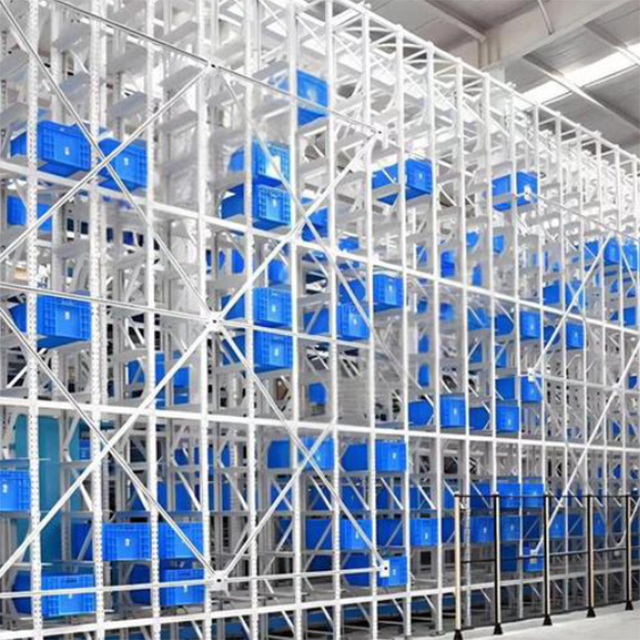
Mini-Load & Micro-Fulfillment Systems: These cater primarily to plastic totes and cardboard cartons. They excel in high-velocity e-commerce picking scenarios. Mechanics feature smaller, notably faster retrieval cranes. Alternatively, they use intelligent shuttle systems navigating dense rack structures. They prioritize rapid acceleration and item delivery speed over pure weight capacity.
Shuttle-Based & Cube Storage Variations: These deliver extremely high throughput rates. They adapt exceptionally well to asymmetrical warehouse layouts. Mechanics rely entirely on autonomous robots. These individual bots move independently along dedicated rack tracks or atop a solid grid structure. They easily bypass offline units to maintain continuous fulfillment flow.
An automated setup transforms basic static metal structures into high-speed dynamic engines. You stop storing items and start actively managing inventory flow. Let us closely examine specific efficiency drivers.
Volumetric optimization changes your facility layout completely. Eliminating standard forklift aisles allows for deep-lane, floor-to-ceiling storage profiles. You compress your active storage footprint significantly. Facilities often double their total storage capacity without ever expanding the actual building walls.
Throughput acceleration relies on a proven goods-to-person methodology. You physically shift from a "picker traveling to goods" model to a "goods delivered to picker" workflow. Workers simply stand at highly ergonomic picking stations. The robotic system feeds them items continuously. This single workflow change drastically increases your lines picked per hour (UPH).
Software-driven inventory control acts as the central brain. Warehouse Execution Systems (WES) and Warehouse Management Systems (WMS) integrate directly into the mechanical hardware. They dynamically optimize bin slotting based on seasonal demand or precise order velocity. Fast-moving seasonal items automatically move closer to the primary picking stations.
Engineering uptime ensures highly consistent daily output. Mechanical precision drastically reduces accidental rack impacts. You drop far fewer pallets overall. You experience significantly fewer product write-offs. Clean automation actively reduces daily physical wear and tear on your valuable inventory.
Efficiency Metric | Traditional Manual Storage | Automated Storage ASRS |
|---|---|---|
Space Utilization | 40% - 50% max cubic density | Up to 85% high cubic density |
Picking Workflow | Person-to-Goods (high travel time) | Goods-to-Person (zero travel time) |
Inventory Accuracy | Prone to costly human error (95-98%) | System-directed precision (99.9%+) |
Safety Profile | High risk of forklift rack impacts | Isolated robotic zones reduce hazards |
Selecting the right integration partner requires a rigid evaluation framework. Do not rush this critical assessment phase. You must protect your capital investment by asking vendors very specific engineering questions.
First, rigorously assess structural and footprint compatibility. Determine if your existing concrete slab supports the severe point loads of high-density arrays. You must actively evaluate brownfield integration against greenfield builds. Retrofitting an existing brownfield facility presents unique structural constraints. It often disrupts your current daily workflows. Conversely, greenfield construction often utilizes rack-supported buildings. Here, the exterior facility walls and roof attach directly to the metal racking. The structure literally acts as the primary building framework.
Second, mandate strict load profiling and standardization. Automated machinery requires exact physical dimensional compliance. Uniform pallets and high-quality rigid totes prevent frustrating system faults. Loose shrink wrap or broken wooden pallet boards quickly cause mechanical jams. You must enforce strict vendor inbound packaging compliance.
Third, deeply scrutinize scalability and modularity limits. You must ask vendors if system throughput can scale easily over time. Can you seamlessly add more shuttles or cranes next year? Can you do this without completely tearing down the existing steel structure? Modular systems protect you heavily against sudden business growth spikes.
Finally, demand proven software interoperability. Request clear vendor API documentation upfront. Verify their actual real-world integration track records. They must connect seamlessly to your existing ERP or WMS software ecosystem. Do not accept beta software versions for critical enterprise-level fulfillment operations.
You must set highly realistic expectations before breaking ground on any new project. Full robotic deployment features a remarkably challenging integration timeline. Timelines often range from 9 to 24 full months. Global supply chain lead times heavily dictate this schedule. Custom engineering complexity adds further delays. Hardware manufacturing simply takes adequate time.
Downtime mitigation requires proactive tactical planning. We strongly recommend phased rollout strategies. Phasing ensures you maintain vital ongoing warehouse operations during active installation. You cannot afford to halt daily customer fulfillment completely. Keep legacy systems running smoothly while actively building the new automated zone nearby.
Next, boldly acknowledge unavoidable maintenance realities. Advanced robotics introduce highly complex electromechanical maintenance requirements. You will likely need to hire specialized on-site technicians. Alternatively, you must secure incredibly robust vendor service level agreements (SLAs). Proper preventative maintenance prevents catastrophic mechanical failures.
Finally, directly address the single point of failure risk. Operations managers naturally fear unexpected system crashes. You must rigorously evaluate available hardware redundancies. Demand manual override capabilities for critical storage zones. Review standard software uptime guarantees thoroughly before signing any binding contracts.
Operators must carefully balance upfront capital expenditure against long-term operational savings. Value generation goes far beyond simple floor space recovery. The operational math eventually strongly favors smart automation.
Analyzing cost versus value reveals powerful operational expense reductions. You reduce daily labor headcount drastically. You rely far less on expensive seasonal temp agencies. You successfully delay the pressing need for expensive future facility expansions. Additionally, dark or cold storage environments see substantially lower daily energy costs. Automation operates perfectly without standard overhead facility lighting.
Before calculating exact returns, you must establish a firm baseline. We advise operators to comprehensively audit current internal metrics. Calculate your exact operational cost-per-pick. Measure your true spatial utilization footprint accurately. Do this thoroughly before ever engaging any outside vendors.
During formal vendor engagement, demand highly customized data. Request distinct software simulation models based strictly on your actual historical order data. Never accept theoretical maximums from a glossy sales brochure. Real-world data ensures your projected financial returns remain highly accurate and realistically achievable.
Transitioning to automated infrastructure represents a massive strategic operational shift for any growing business. You effectively trade upfront capital and initial integration complexity for long-term operational predictability. You immediately gain immense storage density and unmatched fulfillment speed. Properly aligning your hardware capabilities with specific physical load profiles prevents costly mechanical faults.
We strongly encourage readers to take the next practical step immediately. Schedule a comprehensive facility throughput audit today. Speak directly with a qualified systems integration engineer. They will assess your structural slab readiness accurately. They will help build highly realistic baseline ROI timelines specifically tailored for your modern business operations.
A: Rarely without heavy modification. An automated system requires significantly tighter manufacturing tolerances. It also demands much higher load-bearing capacities than standard teardrop racking. Retrofitting old structural steel often proves more expensive than installing entirely new, precision-engineered frameworks. Starting fresh ensures peak mechanical reliability and absolute safety compliance.
A: Most modern systems easily handle 1,000 to 3,000 lbs per pallet. Specialized configurations go even higher. Custom heavy-duty variations exist for dense industrial manufacturing loads. Engineers carefully calculate concrete slab point loads. This ensures the floor safely supports these extreme vertical weights without cracking over time.
A: It performs exceptionally well. Automation actively minimizes the need for human labor in harsh, sub-zero environments. Furthermore, it allows for a drastically denser, smaller overall footprint. This extreme cubic density dramatically reduces daily energy usage. It ultimately lowers ongoing facility cooling costs while preserving product integrity.
A: Reputable installations require robust Uninterruptible Power Supply (UPS) backups. They also feature localized server redundancies to seamlessly maintain data integrity. Furthermore, facilities implement specific manual retrieval protocols. These critical safety nets actively prevent total operational paralysis during unexpected utility grid or network outages. Your inventory remains highly accessible.