- All
- Product Name
- Product Keyword
- Product Model
- Product Summary
- Product Description
- Multi Field Search

Views: 0 Author: Site Editor Publish Time: 2026-07-19 Origin: Site
Operating a temperature-controlled warehouse requires massive capital. The cost per square foot to build, insulate, and maintain a freezer facility vastly exceeds ambient storage. Facility managers face an ongoing conflict: maximizing pallet positions while minimizing the cubic volume of air that must be continuously cooled. Every empty cubic foot of aisle space represents wasted energy.
High-density storage solutions act as the primary lever for controlling these operational expenditures. By changing how pallets are stored, warehouse operators drastically shrink the physical footprint required for inventory. This objective evaluation examines how specific racking architectures impact long-term operational costs, focusing on structural design, thermal efficiency, and inventory flow.
Density-to-Energy Ratio: High-density configurations can increase pallet capacity by up to 75% in the same footprint, directly reducing the energy cost per stored pallet.
Footprint Optimization: Condensing storage volume lowers initial construction costs, insulation requirements, and ongoing refrigeration demands.
Inventory Flow Constraints: The system relies on Last-In, First-Out (LIFO) inventory management, making it viable only for specific SKU profiles (low SKU count, high volume per SKU).
FEFO/FIFO Compliance: Standard drive-in is LIFO, but drive-through configurations can accommodate First-In, First-Out (FIFO) and First-Expired, First-Out (FEFO) protocols for perishable cold chain goods.
Operational Trade-offs: The financial gains of density must be weighed against slower throughput speeds and the requirement for rigorous forklift operator training to prevent structural damage.
The thermodynamics of cold storage dictate that cooling empty space drives energy waste. Refrigeration systems work continuously to remove heat from the air. When a warehouse utilizes standard selective racking, up to 60% of the floor space is dedicated to forklift aisles. This creates a massive volume of empty, chilled air providing zero financial return. Every time a dock door opens, warm air enters and mixes with this empty volume. Compressors then run longer cycles to stabilize the environment.
Density directly combats this inefficiency through thermal mass. A solid block of frozen pallets acts as a massive heat sink. Frozen goods retain their temperature much longer than ambient air. When pallets are packed tightly together, they stabilize the surrounding temperature. This reduces internal convection currents and minimizes the refrigeration load during peak demand hours. The inventory itself helps keep the room cold.
Construction realities further highlight the penalty of inefficiency. A smaller physical footprint requires less structural steel, reduced roofing square footage, and fewer specialized thermal insulation materials. Under-slab heating systems, insulated wall panels, and ceiling barriers are specified by the square foot. Condensing the storage volume slashes the initial capital required to build the envelope. Utilizing standard selective racking in a freezer environment wastes vertical and horizontal space. It inflates the building size and guarantees higher lifetime utility consumption.
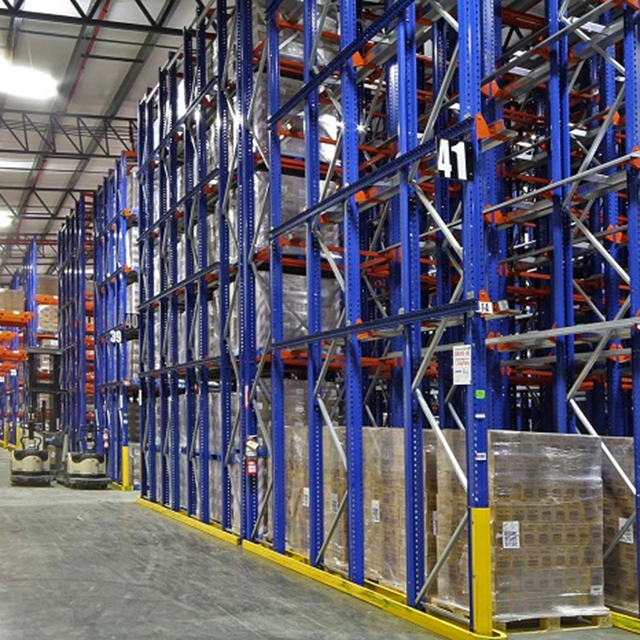
The structural design of Drive in Racking eliminates standard forklift aisles entirely. Instead of facing the rack from an aisle, operators drive their material handling equipment directly into the storage lanes. Pallets rest on continuous rails running the depth of the structure. This allows inventory to be stored multiple positions deep. It transforms previously wasted aisle space into revenue-generating pallet positions.
This dense configuration directly correlates with improved thermal efficiency. Removing the aisles packs the cubic volume of the room with product rather than air. Lowering cooling costs becomes a matter of basic physics. Less air to cool means shorter compressor cycles and lower electricity consumption. The tight packing of pallets restricts airflow between loads. This prevents warm air from circulating easily through the stored goods.
Maximizing vertical space is another critical factor. Engineering requirements allow these systems to be built up to the ceiling. This capitalizes on vertical cube utilization without expanding the building footprint. Heavy-duty uprights and specialized bracing ensure stability even at extreme heights. Vertical integration means a facility can store thousands of additional pallets without pouring a single extra yard of concrete.
During the design phase of a new freezer facility, selecting high-density racking drastically reduces overall land acquisition and envelope construction costs. The capital expenditure reduction is immediate. Building a smaller, taller, and denser facility costs significantly less than sprawling a selective rack system across a massive warehouse floor. The savings on insulated panels and concrete alone often offset the cost of the racking structure.
Operational prerequisites dictate whether this system fits a specific warehouse. The inherent LIFO restriction means the last pallet deposited into a lane must be the first one removed. Ideal SKU profiles include seasonal goods, batch production runs, and long shelf-life frozen items. Facilities handling a low number of unique SKUs but a high volume of pallets per SKU benefit the most. If a warehouse processes thousands of distinct, low-volume items, lane utilization drops. This negates the density advantages.
Evaluating configurations requires understanding inventory flow. Standard systems operate on LIFO. Adding a secondary access aisle transforms the structure into a drive-through configuration. Operators load from one side and pick from the other. This supports strict First-In, First-Out (FIFO) or First-Expired, First-Out (FEFO) expiration-date tracking. This modification is critical for sensitive food and pharmaceutical products requiring rigorous cold chain compliance.
Warehouse managers must evaluate the acceptable loss in picking speed against the financial gains of increased storage capacity. Throughput velocity decreases because operators must navigate carefully into narrow, deep lanes. Depositing or retrieving a pallet deep within the structure takes longer than grabbing a front-facing pallet from a selective rack. This trade-off is generally acceptable in cold storage. Space costs far outweigh minor increases in labor time.
High-density storage protects cold chain temperature integrity. Dense packing minimizes internal airflow turbulence. When doors open for loading and unloading, solid blocks of inventory resist temperature fluctuations. This maintains consistent sub-zero conditions across the stored goods.
Equipment compatibility requires attention. Standard wide-aisle forklifts cannot enter the lanes. Facilities must utilize specialized material handling equipment. Narrower counterbalanced forklifts or reach trucks are mandatory. These vehicles need cold-conditioned cabins for operator safety. They also require modified overhead guard clearances to navigate the racking lanes without striking the support rails.
To properly evaluate drive in pallet racking for your operation, follow these steps:
Conduct a comprehensive SKU profiling analysis to determine your average pallets-per-SKU ratio.
Map your current inventory flow to identify strict FIFO/FEFO requirements versus acceptable LIFO tolerances.
Measure existing forklift dimensions, specifically overhead guard width and chassis turning radius.
Calculate the cubic volume of your facility to determine potential vertical expansion limits.
Audit current energy consumption metrics to establish a baseline for future efficiency comparisons.
The primary risk associated with deep-lane systems is structural damage. Operators drive directly into the rack structure under sub-zero conditions. Cold temperatures make standard steel more brittle. The confined space leaves little room for error. A forklift impact against an upright deep inside a lane can compromise the entire structure.
Mitigation tactics are mandatory. Heavy-duty column protectors must be installed on all front-facing uprights. Floor-mounted guide rails are essential. They physically funnel the forklift into the center of the lane. This prevents the chassis from scraping the uprights. Recessed front legs can also be engineered into the design. This provides operators with a wider turning radius when entering the system.
Operator training and safety protocols must be rigorous. Navigating deep lanes in sub-zero environments is difficult. Visibility is often compromised by cold weather gear. Floor traction can be reduced by frost or ice condensation. Operators must be trained specifically on deep-lane entry, speed control, and the exact dimensional tolerances of their equipment relative to the rack.
A strict maintenance and inspection cadence prevents catastrophic failure. Hidden damage in deep lanes is common because operators may not report minor impacts. Scheduled structural inspections must occur monthly. Inspectors need to walk every lane, checking for deflected uprights, damaged rails, and sheared anchor bolts.
When evaluating storage density, standard selective racking offers 100% selectivity but poor space utilization. Deep-lane configurations provide up to a 75% density gain over selective systems. The break-even point for SKU volume typically occurs when a facility stores five or more pallets per SKU. Below that threshold, selective racking remains necessary to prevent honeycombing.
Pallet shuttle systems present a semi-automated alternative. Shuttles run on rails to deposit and retrieve pallets. This removes the need for forklifts to enter the structure. It reduces rack damage and increases throughput speed. The initial capital expenditure for shuttles and their specialized racking is significantly higher than manual systems. The cost-to-benefit ratio favors shuttles only in extremely high-throughput environments.
Pallet flow, or gravity live racking, contrasts static channels with gravity-fed roller systems. Flow systems provide excellent FIFO selectivity and high density. Maintaining moving parts in freezing conditions introduces ongoing maintenance costs. Rollers and speed controllers can freeze or degrade. Static channels have no moving parts, making them highly reliable in harsh sub-zero environments.
Mobile racking mounts selective racks on motorized bases that move along floor tracks to open a single access aisle. Mobile systems offer high density and 100% selectivity. They require extensive floor track installation and ongoing maintenance of heavy-duty motors. Implementing cold storage drive in racking provides a static, deep-lane approach. This avoids the mechanical complexities and energy consumption associated with moving entire rack structures.
System Type | Density Gain | Selectivity | CapEx Level | Maintenance Needs |
|---|---|---|---|---|
Selective Racking | Baseline | 100% | Low | Low |
Drive-In Racking | Up to 75% | LIFO Only | Medium | Medium (Impact checks) |
Pallet Shuttle | Up to 80% | LIFO/FIFO | High | High (Battery/Motors) |
Pallet Flow | Up to 70% | FIFO Only | High | High (Rollers/Brakes) |
Calculating the payback period requires comparing the initial capital expenditure of the racking system against the monthly operational savings. The ROI formula for high-density upgrades factors in energy reduction, labor efficiency, and footprint optimization. You must quantify the reduction in kilowatt-hours used for refrigeration, the reduced cost of building maintenance, and the value of deferred facility expansion.
Consider a hypothetical case analysis. A company plans to build a freezer to hold 5,000 pallets. Using selective racking, they require a 10,000 square foot facility. The construction, insulation, and refrigeration equipment costs are massive. By switching to a deep-lane configuration, they condense the requirement to a 6,000 square foot facility with equal pallet capacity. The savings on 4,000 square feet of insulated panels, concrete slab, and roofing immediately offset the higher cost of the dense racking steel. The smaller room requires less refrigeration tonnage. This yields a monthly energy savings that accelerates the payback period to under 24 months.
Initiate a SKU profiling analysis to confirm your inventory meets the high-volume, low-SKU count requirements for deep-lane storage.
Commission a structural engineering survey to evaluate your current concrete slab load capacities and ceiling clearances.
Consult with material handling equipment providers to verify your existing forklift fleet can navigate narrow-lane configurations safely.
Request a thermodynamic audit of your facility to project exact energy savings based on reduced cubic volume.
A: It typically provides a 50% to 75% increase in storage density. This gain depends heavily on the engineered lane depth and the available ceiling height utilized for vertical storage.
A: Standard configurations operate strictly on Last-In, First-Out (LIFO). Achieving true First-In, First-Out (FIFO) requires a drive-through configuration, which necessitates access aisles at both ends of the rack.
A: Drive-in systems have one entry point, maximizing space but restricting flow to LIFO. Drive-through systems open both ends, sacrificing some density for an extra aisle but facilitating FIFO/FEFO compliance for perishables.
A: It reduces the cubic feet of air per pallet position. Less empty air means lower refrigeration cycle times. Additionally, tightly packed frozen pallets act as a thermal mass, stabilizing temperatures and lowering energy consumption.
A: Operators must use narrower counterbalanced forklifts or reach trucks. These vehicles often require modified overhead guards and cold-conditioned cabins to safely fit and operate within the tight lane dimensions.
A: Yes, the risk is high because operators drive directly into the structure. Required safety accessories include heavy-duty floor guide rails, column protectors, and specialized steel engineered for brittle freezer environments.
A: Standard depth ranges from 2 to 10 pallets deep. While deeper lanes maximize density, they also increase handling time and require stricter inventory control to prevent honeycombing.