- All
- Product Name
- Product Keyword
- Product Model
- Product Summary
- Product Description
- Multi Field Search

Views: 0 Author: Site Editor Publish Time: 2026-07-31 Origin: Site
Improper loading in industrial storage carries severe operational and financial risks. Catastrophic structural failures, widespread inventory damage, and severe workplace injuries occur when facilities ignore the strict physics governing material handling. Storing oversized, unbalanced, or exceptionally heavy inventory like steel piping, lumber, and extrusions requires specialized protocols. Standard pallet racking simply cannot support these dimensions. Facility managers face a constant challenge: balancing maximum storage density with strict structural safety limits.
To mitigate these hazards, operators must adopt a systematic, engineering-based approach to loading long materials. This strategy focuses heavily on load distribution, equipment verification, and strict operational compliance. By understanding the mechanical limits of your storage systems, you can maximize the lifespan and safety of your Heavy Duty Cantilever Racks. The following guidelines provide actionable steps to ensure every load is placed securely, protecting both your personnel and your inventory.
Load Stratification: Always place the heaviest materials on the base level to maintain a low center of gravity and prevent system tipping.
Deflection Management: Long loads must be supported by an adequate number of arms to prevent material sagging (deflection), which alters the load’s center of gravity and stresses individual arms.
Capacity Verification: Column height, arm length, and base dimensions directly dictate load capacity; loading must strictly adhere to manufacturer-specified weight limits.
Mandatory Anchoring: Safe loading is impossible without proper base anchoring to the concrete floor to counteract the overturning moment during loading and unloading.
Spatial Awareness: Proper spatial planning and aisle design are critical to prevent vehicle-rack collisions when maneuvering long loads in tight spaces.
The relationship between a load's center of gravity and the rack's base dictates system stability. When you place heavy materials on elevated arms, you raise the overall center of gravity. This increases the overturning moment, making the entire structure vulnerable to tipping. Horizontal load distribution prevents torsional stress on the upright columns. If a load rests unevenly across the arms, the column experiences twisting forces it was not engineered to withstand. You must ensure the weight is spread evenly across all contact points.
Calculating the correct number of arms requires analyzing the material's length, weight, and rigidity. A common field method involves dividing the material length by the number of supporting arms, ensuring the overhang on either end does not exceed one-half the distance between the arm centers. This formula guarantees the load remains balanced and prevents localized point-loading on a single connection point. For example, a 20-foot steel pipe requires specific arm spacing to prevent the ends from acting as levers against the center supports.
Standard Load Distribution Guidelines for Long Materials | |||
Material Length | Minimum Number of Arms | Maximum Allowable Overhang | Load Distribution Profile |
|---|---|---|---|
10 - 12 Feet | 2 to 3 Arms | 2.5 Feet per side | Evenly distributed across center span |
14 - 16 Feet | 3 to 4 Arms | 3.0 Feet per side | Requires center support to prevent sag |
18 - 24 Feet | 4 to 6 Arms | 4.0 Feet per side | Strict multi-point distribution required |
Material deflection refers to the sagging that occurs when long, flexible items lack sufficient support underneath. Deflection forces the weight of the material to shift inward or outward, point-loading specific rack arms beyond their rated capacity. When utilizing long load cantilever racks, operators must monitor this sagging closely. Flexible materials like PVC piping or thin-gauge aluminum extrusions are particularly susceptible to this phenomenon.
Acceptable overhang limits generally dictate that the unsupported ends of the material should measure exactly one-half the distance between the upright centers. Exceeding this limit causes lateral instability. Furthermore, dynamic loading forces multiply the risks. Dropping deflected materials abruptly onto the arms generates shock loads that can easily shear pins or fracture bolted connections. Operators must lower loads smoothly to allow the material to settle onto the arms without bouncing.
Measure the total length of the material bundle before approaching the storage bay.
Calculate the exact distance between the supporting arms on the target level.
Verify that the overhang on both the left and right sides does not exceed 50% of the arm spacing.
Visually inspect the material for excessive sag once placed; if sagging occurs, relocate to a bay with closer arm spacing.
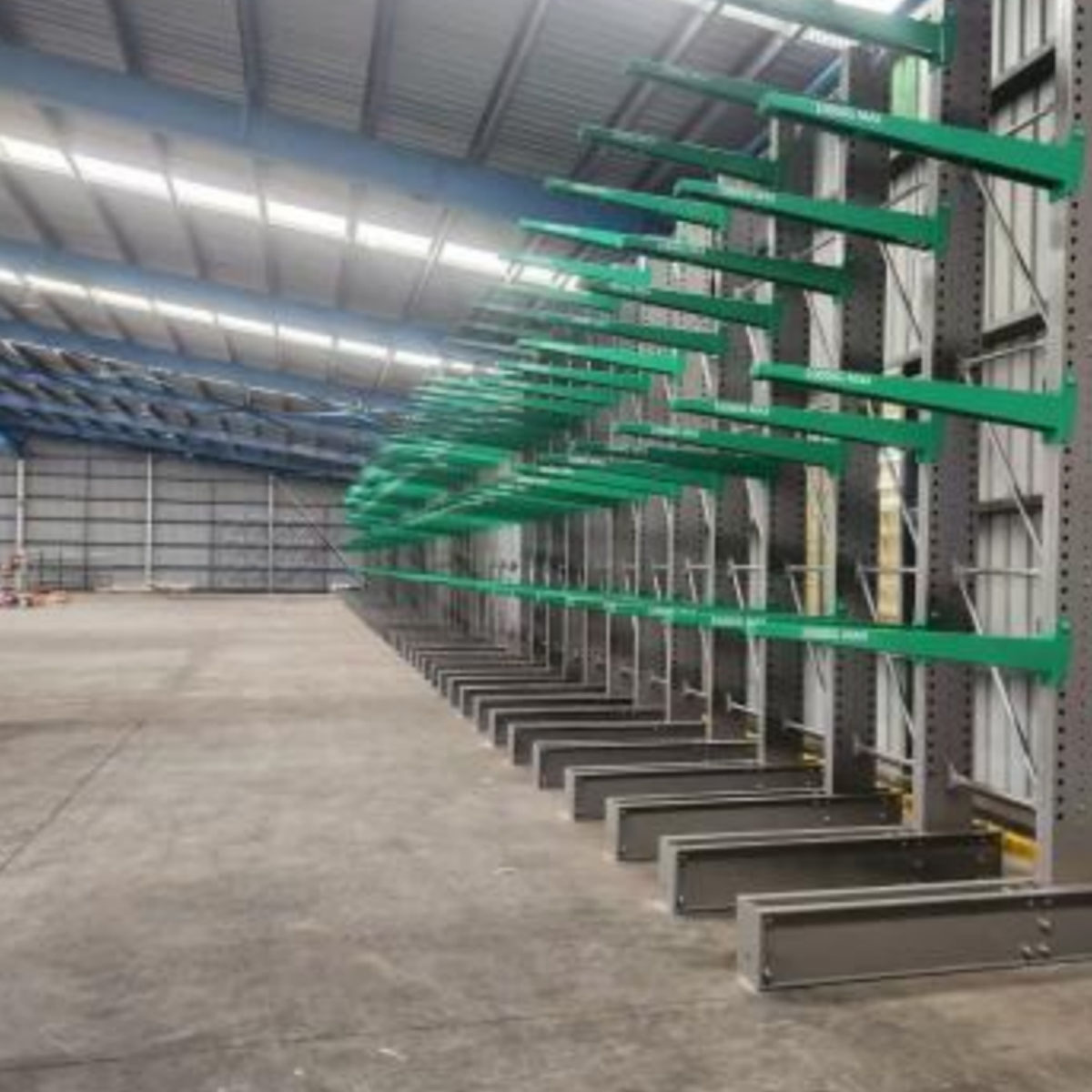
Open-front storage systems eliminate front vertical columns. This design provides a massive mechanical benefit, allowing unobstructed horizontal loading of exceptionally long materials. Forklift operators can maneuver cumbersome loads directly into the storage slot without navigating around front uprights. This drastically reduces loading time and minimizes the risk of damaging the material during placement. It allows for high-density storage of items that would be impossible to load into standard selective pallet racks.
However, this open design introduces specific hazards. Without front columns acting as visual guides, operators often misjudge horizontal clearance. This misjudgment leads to accidental arm impact. When a forklift strikes an arm horizontally, it transfers immense twisting force directly to the upright column, potentially causing permanent structural deformation. Operators must maintain strict spatial awareness and approach the storage bay at a perfect 90-degree angle to avoid clipping the arms with the load or the forklift mast.
Column height directly impacts overall system capacity. Taller columns generally reduce the maximum allowable load per level due to the increased leverage acting on the base. You must differentiate between arm capacity, column capacity, and total system capacity. An arm might hold 2,000 pounds, but the column might only support 10,000 pounds total per side. Loading six arms to maximum capacity would instantly overload the column, leading to a catastrophic collapse.
Assuming uniform capacity across different rack configurations is a dangerous operational error. Always consult the specific manufacturer documentation for the exact system you are loading. A slight variation in steel gauge or base dimension completely alters the safe working load. Facility managers must ensure that load capacity plaques are clearly visible and accurately reflect the specific engineering specifications of each individual storage row.
Capacity Verification Checklist | ||
Component | Verification Metric | Failure Risk if Ignored |
|---|---|---|
Individual Arm | Max weight per arm (static) | Arm deflection, pin shearing, localized failure |
Upright Column | Total weight per side (cumulative) | Column buckling, structural twisting, total collapse |
System Base | Overturning moment resistance | Forward tipping, anchor pull-out, floor damage |
Anchoring requirements depend heavily on seismic zones and specific load requirements. Heavy industrial storage requires heavy-duty wedge anchors or epoxy anchors driven deeply into the concrete slab. Secure base anchoring is mandatory to prevent tipping. When a forklift extracts a heavy load, it exerts forward-pulling forces due to friction. Without proper anchors, the entire rack can pivot forward, endangering the operator and surrounding personnel.
Before loading to maximum capacity, evaluate the concrete slab’s PSI and thickness. A high-capacity rack is useless if the floor beneath it cracks under the pressure. During pre-load inspections, actively look for signs of base plate stress, concrete spalling, or anchor pull-out. Any visible gap between the base plate and the floor requires immediate engineering review. You cannot rely on the weight of the base alone to stabilize a fully loaded system.
Safely operating forklifts carrying long materials requires meticulous spatial layout planning. Side-loaders, multi-directional trucks, and standard counterbalanced forklifts all demand different turning radii. Safe aisle width standards must accommodate the maximum length of the materials being stored, plus a safety margin for operator maneuvering. A 20-foot load requires significantly more clearance than a standard pallet, especially when turning into an aisle from a main thoroughfare.
In narrow-aisle configurations, integrating guide rail systems minimizes forklift-to-rack collision risks. These rails keep the material handling equipment perfectly aligned with the storage system, preventing the tail swing of a long load from striking adjacent uprights or stored inventory. Proper aisle planning also involves designating specific traffic flow directions to prevent bottlenecks and reduce the likelihood of equipment collisions in tight spaces.
The fundamental operational rule for vertical load placement is simple: put the heaviest loads on the base, and place progressively lighter loads on the upper arms. This practice drastically lowers the system's center of gravity. A low center of gravity inherently mitigates overturning moments, creating a highly stable structural footprint. It also makes the heaviest items easier and safer to access, reducing the lifting height required by the forklift.
Operators must strictly enforce this rule during inventory rotation. Placing a dense bundle of solid steel bar stock on the top tier while leaving the base empty creates a severe tipping hazard, regardless of the rack's overall capacity rating. Facility managers should implement visual zoning, marking the lower levels specifically for high-density materials and restricting the upper levels to lighter, bulkier items like insulation or hollow tubing.
Forklift operators must drive loads in squarely. Approaching at an angle invites lateral impacts on the arms, which degrades the column connection over time. Utilize the open-front design carefully to ensure you do not catch or drag adjacent materials during insertion or extraction. The operator must have a clear line of sight to the target arms and the surrounding inventory.
Always place materials as close to the upright column as possible. This minimizes the moment arm, or leverage, acting on the connection point. The further out the weight sits on the arm, the greater the stress on the column. Finally, lower loads gently. Dynamic shock loading from dropping heavy inventory can easily exceed static capacity ratings and cause immediate failure. The load must be fully supported by the arms before the forklift forks are withdrawn.
Align the forklift perfectly parallel to the storage bay before lifting the load.
Elevate the load 3 to 4 inches above the target arms to ensure clear passage.
Drive forward slowly, keeping the mast completely vertical.
Position the load as close to the upright columns as physically possible.
Lower the forks smoothly until the weight is entirely transferred to the rack arms.
Reverse slowly, ensuring the forks do not drag against the bottom of the material.
Arm stops come in several variations, including pipe pins, bolted lips, and welded end stops. Pipe pins offer flexibility for changing inventory, while welded stops provide permanent security. You must match the stop type to the specific material being stored. For example, storing large-diameter steel pipes requires heavy-duty welded stops, while storing flat lumber might only require removable pipe pins to prevent accidental shifting.
It is mandatory to understand that arm stops are designed solely to prevent cylindrical items like PVC or steel pipes from rolling off the edge. They are not engineered to bear the primary outward force of an improperly seated load. Relying on an arm stop to hold back a load that is sliding due to severe arm deflection will result in the stop shearing off. The primary retention method must always be proper load placement and maintaining a level or slightly upward-tilted arm angle.
Rigid, high-density materials like steel beams require precise point-load calculations but generally do not suffer from severe deflection. Flexible, variable-density materials like engineered lumber require closer arm spacing to prevent sagging. Material characteristics dictate the necessary arm spacing and whether decking is required. You must evaluate the specific physical properties of your inventory before configuring the storage bay.
Wire mesh or solid steel decking placed across the arms creates a continuous shelf. This is highly effective for storing bundles of lumber, flexible extrusions, or mixed-length items that would otherwise slip between standard arm gaps. Decking distributes the weight more evenly across the arms, reducing the risk of localized point-loading and providing a safer surface for materials that lack inherent structural rigidity.
Structural steel systems utilize heavy bolted connections and offer exceptional impact resistance. They are ideal for harsh environments and extremely heavy loads. Roll-formed options use pin connections and are more cost-effective for lighter loads. They offer easier adjustability but cannot withstand the same level of forklift impact. When selecting heavy duty cantilever racks, you must weigh these factors against your operational demands.
The choice of rack material directly impacts long-term durability, maintenance costs, and maximum safe loading parameters. Facilities handling massive steel plates or heavy machinery components should always opt for structural steel. Those storing light PVC tubing, aluminum extrusions, or lightweight timber can safely utilize roll-formed systems, provided they strictly adhere to the lower capacity limits and implement robust forklift safety protocols.
The most common causes of overloading include undocumented inventory changes, operator error, and ignoring asymmetric loading limits. When inventory profiles change, operators often fail to recalculate load distribution. Visual indicators of structural stress include arm deflection that exceeds the engineered upward tilt, column twisting, or sheared connection hardware. You must train your staff to recognize these warning signs immediately.
If an arm remains deflected after a load is removed, the steel has yielded, and the arm must be replaced immediately. Never attempt to bend structural components back into place. Yielded steel has lost its structural integrity and will fail unpredictably under future loads. Implement a strict reporting system where operators can flag damaged components without fear of reprisal.
The Occupational Safety and Health Administration (OSHA) and the Rack Manufacturers Institute (RMI) set strict regulatory requirements for storage safety. Compliance ensures a safe working environment and protects the facility from severe liability. Obtaining local building permits and complying with seismic regulations is mandatory, particularly when erecting tall or high-capacity systems. Ignoring these codes can result in massive fines and facility closures.
Codes require visible load capacity plaques displaying the engineered configuration limits. These plaques must be mounted at the end of every aisle, clearly stating the maximum load per arm and per column. They must also detail the specific rack configuration, including arm spacing and column height. If you alter the rack configuration, you must obtain updated engineering documentation and replace the capacity plaques accordingly.
Safety requires a rigorous inspection schedule. Operators should perform daily visual checks, looking for obvious impact damage or missing safety pins. Facility managers must conduct thorough monthly audits, documenting any signs of stress or improper loading practices. These audits should include checking anchor bolts for tightness and verifying that all loads comply with the posted capacity limits.
Finally, schedule annual third-party engineering inspections. Independent experts can identify microscopic fractures, verify anchor integrity, and ensure the system remains fully compliant with current safety standards. They provide an objective assessment of your storage infrastructure, identifying potential hazards that internal staff might overlook due to familiarity.
Daily: Operators visually inspect arms for deflection and check for missing safety pins before loading.
Weekly: Supervisors verify that the heaviest loads are correctly stratified on the bottom levels.
Monthly: Maintenance teams check anchor bolt torque and inspect base plates for concrete spalling.
Annually: Certified rack inspectors conduct a comprehensive structural audit and update capacity documentation.
Implement a strict base-heavy loading policy immediately to stabilize all long material storage systems. Train all forklift operators on square-approach techniques and the dangers of dynamic shock loading. Schedule a comprehensive audit of your current rack anchoring and column capacities this week. Finally, install highly visible load capacity plaques on every storage row to eliminate operator guesswork.
A: The most common mistake is placing the heaviest loads on the upper arms instead of the base. This raises the center of gravity and significantly increases the risk of the entire structure tipping over.
A: Prevent sagging by ensuring the material is supported by an adequate number of arms. The overhang on either end should never exceed one-half the distance between the supporting arm centers.
A: No. Arm stops are designed only to prevent cylindrical items from rolling. They are not engineered to withstand the outward pressure of an improperly seated or excessively heavy load.
A: Dropping a load creates dynamic shock loading. This sudden force can easily exceed the static capacity rating of the arms and columns, leading to immediate structural failure or sheared connections.
A: Operators should conduct daily visual checks for obvious damage. Facility managers should perform monthly documented audits, and a third-party engineer should inspect the system annually to ensure ongoing compliance and structural integrity.