- All
- Product Name
- Product Keyword
- Product Model
- Product Summary
- Product Description
- Multi Field Search

Views: 0 Author: Site Editor Publish Time: 2026-05-05 Origin: Site
Storing long, awkward, or bulky materials creates a severe operational bottleneck. Items like lumber, steel pipes, and aluminum extrusions rarely fit onto standard pallet shelves. Leaving these materials on the floor consumes valuable warehouse space and creates significant safety hazards.
Inefficient storage strategies lead to hidden operational penalties across your facility. You risk damaged inventory, excessive forklift handling times, and a completely wasted vertical footprint. Facilities lose productivity every time a driver struggles to maneuver around poorly stacked bundles.
Heavy duty cantilever racks provide an engineered solution for unobstructed, high-density vertical storage. This guide explores the core engineering principles and structural components defining these systems. Procurement and facility managers will learn exactly what they need to know before shortlisting a system.
Open-Front Design: Eliminates frontal column restrictions, allowing for the storage of continuous, oversized materials and side-loading via forklift.
Material Choice Dictates Capacity: Roll-formed steel suits medium/light applications, while hot-rolled structural steel is mandatory for high-capacity, heavy-impact environments.
Engineering Strictness: Safe deployment requires precise calculation of Uniformly Distributed Load (UDL), proper lateral spacing to prevent material deflection, and strict floor-anchoring compliance.
Modular Scalability: Systems can be configured as single-sided (wall-adjacent) or double-sided (center-aisle) and expanded with add-on units as facility needs grow.
Most warehouses rely heavily on traditional pallet systems. However, these conventional shelves present immediate physical limitations when handling specialized inventory. Standard pallet racks utilize rigid front vertical uprights. These posts restrict material length strictly to the width of a single bay. Operators must load all items directly from the front. This physical boundary makes storing continuous, oversized materials virtually impossible without creating highly dangerous overhangs.
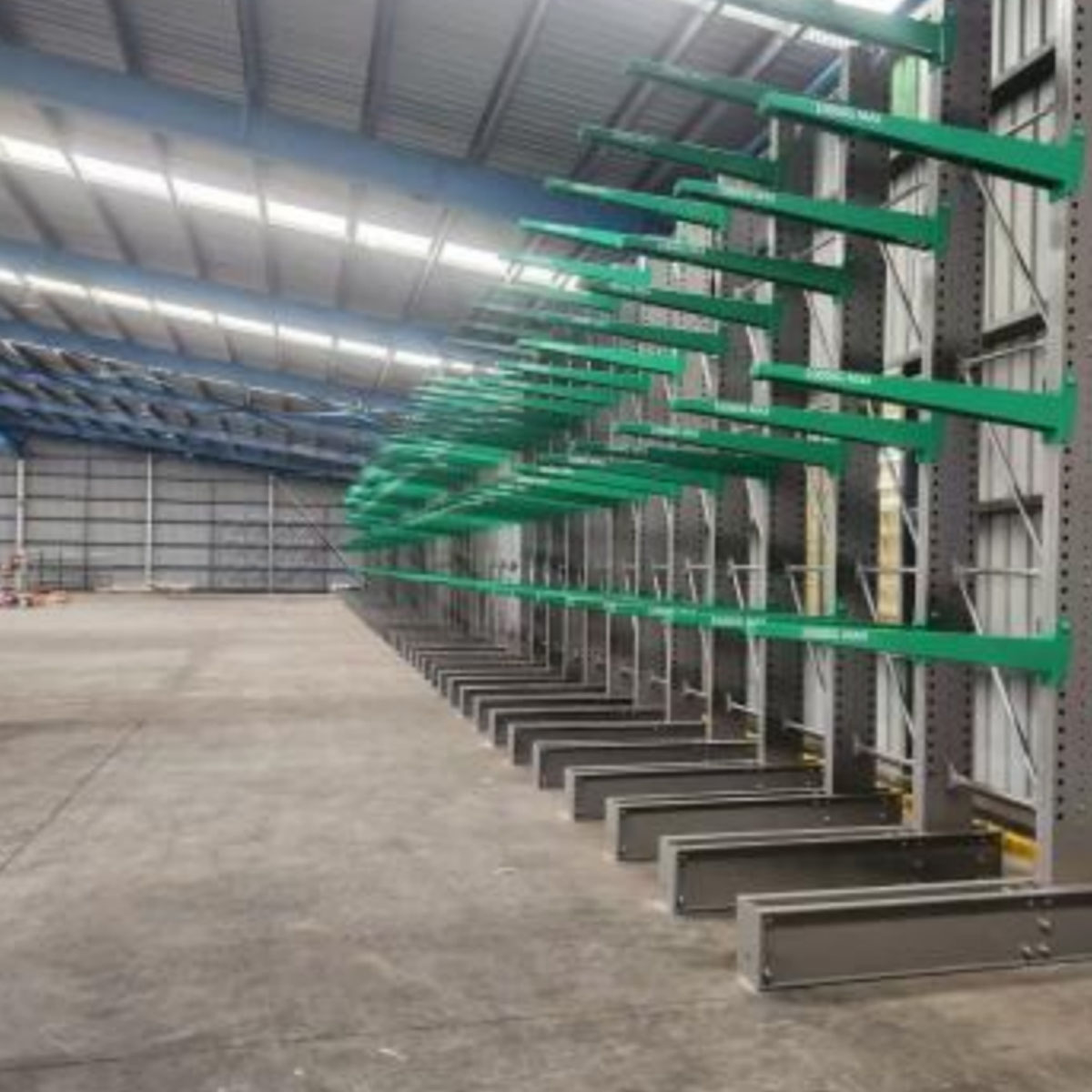
The core advantage of Cantilever Racks lies in their completely open-front design. Because they lack restrictive front posts, they remove all horizontal length barriers. Materials spanning 10, 20, or even 30 feet can rest safely across multiple supportive arms. This continuous storage tier eliminates the need to cut materials down to fit onto standard shelves.
Implementing this open-front structure directly improves operational efficiency. First, side-loading access dramatically accelerates forklift maneuverability. Drivers no longer need to thread long bundles through narrow front-facing entry points. Instead, they drive parallel to the system and place the load directly onto the arms. This reduces handling time and minimizes the risk of product damage.
Second, this approach achieves massive footprint optimization. You effectively condense horizontal floor sprawl into tightly structured vertical storage. Facilities can reclaim thousands of square feet of usable floor space. By maximizing your existing vertical cube utilization, you often delay the need for disruptive and expensive warehouse expansions.
Understanding how these systems handle massive weight requires breaking down their structural anatomy. Every component plays a critical role in maintaining safety and balance under extreme loads.
The uprights and bases act as the foundational skeleton of the entire structure. Uprights support the arms and bear the total downward force of the inventory. The base extends outward from the upright, anchoring the system and preventing tipping.
Crucial Implementation Rule: Uprights must never be anchored to building walls or support columns. System stability relies entirely on the base being bolted securely to a level, solid concrete floor. A common mistake is attempting to wall-mount uprights to save space, which severely compromises structural integrity and violates safety codes.
The arms project outward from the uprights and directly hold your inventory. Manufacturers design specific arm types to handle different material profiles.
Straight Arms: These sit horizontally and are used for flat, stable materials. Lumber, sheet metal, or plywood bundles sit perfectly securely on straight arms.
Inclined Arms: These arms feature an upward pitch, commonly around 20 degrees. They are absolutely essential for cylindrical loads like pipes and tubing. The incline prevents dangerous roll-off. Operators often supplement inclined arms with removable end stops or welded steel lips for maximum security.
Adjustability: Modern systems utilize pin-keeper mechanisms. These allow toolless vertical adjustments. Operators can quickly adjust arm heights at 3-inch or 4-inch increments to accommodate changing inventory sizes.
While bases prevent forward tipping, bracing systems prevent sideways collapse. X-braces and horizontal braces tie the uprights together down the length of the aisle. They absorb lateral shear forces generated during daily forklift interactions. Without adequate bracing, the system would sway dangerously when loading heavy materials.
Not all heavy-duty racks share the same construction. The choice between steel manufacturing processes directly impacts system capacity, upfront cost, and overall longevity. Facility managers must align the steel type with their specific operational environment.
Manufacturers build structural systems using hot-rolled I-beams. These systems dominate environments handling extra-heavy loads, easily supporting over 1,500 pounds per arm or 10,000 pounds per column.
Pros: They are extremely resilient to forklift impacts. The thick steel and bolted connections provide rigid stability in harsh industrial environments like steel yards or heavy manufacturing plants. They withstand severe abuse over decades of use.
Cons: Structural steel demands heavier shipping weights. Furthermore, the reliance on heavy-duty bolted connections results in longer, more expensive installation processes.
Manufacturers create roll-formed systems by shaping cold steel into specific profiles. They handle medium-to-heavy applications where inventory weights remain predictable and uniform.
Pros: These systems often feature bolt-less or teardrop designs. This allows for rapid assembly and easy reconfiguration. The lighter steel weight significantly reduces freight shipping costs.
Cons: Roll-formed steel is more susceptible to structural damage from equipment collisions. A heavy forklift impact can permanently deform a roll-formed upright, necessitating immediate replacement.
Feature | Structural I-Beam Steel | Roll-Formed Steel |
|---|---|---|
Load Capacity | Extra-Heavy Duty (>1,500 lbs/arm) | Medium to Heavy Duty |
Impact Resistance | Exceptional (Ideal for heavy machinery) | Moderate (Requires careful operation) |
Assembly Method | Heavy-duty bolted connections | Often bolt-less / pin-keeper setups |
Cost Profile | Higher initial material and freight costs | Lower freight and installation costs |
Proper sizing is an exact science. Guesswork leads to collapsed shelves and damaged inventory. Follow this technical, step-by-step Standard Operating Procedure (SOP) to spec your Heavy Duty Cantilever Racks accurately and avoid catastrophic failure.
Step 1: Audit the Load Dimensions & Weight. Before looking at catalogs, document your inventory thoroughly. Measure the maximum length, depth, height, and total weight of your bulkiest items. This data dictates every subsequent engineering choice.
Step 2: Determine Arm Length. Your load depth must never exceed the physical length of the arm. If a load overhangs the front of the arm, it shifts the center of gravity. This creates an uneven stress point failure, risking system collapse. Choose an arm length slightly longer than your widest bundle.
Step 3: Calculate Lateral Spacing & Prevent Deflection. You must prevent long materials from sagging between uprights. Use the "Wood Block Test". Place your material on wooden blocks on the floor. Gradually move the blocks further apart until the material begins to sag or deflect. This maximum distance dictates your upright spacing.
Engineering Rule: The material overhang past the outer arms should always be equal to or less than half the distance between the uprights. This is known as the 1/2 overhang rule.
Step 4: Establish Upright Height. Determine how high you can safely build. Factor in your ceiling clearance. You must adhere to fire sprinkler regulations, which typically require 18 to 36 inches of unobstructed clearance below the deflector. Furthermore, verify your forklift's maximum safe lift height. Always leave a 6-inch safety handling clearance between loaded tiers so forklift forks can enter and exit smoothly.
Step 5: Verify Weight Capacities (UDL). You must understand Uniformly Distributed Load (UDL). Manufacturers rate arm capacities assuming the weight spreads evenly across the entire arm length. They do not rate arms for point-loading at the very tip.
Formula note: Total Load Weight ÷ Number of Arms = Required Arm Capacity. If you have a 4,000-pound bundle resting on four arms, each arm must support a UDL of at least 1,000 pounds.
Purchasing the right system is only half the battle. Deployment requires rigorous attention to environmental conditions and safety regulations. Deploying these racks is a strict structural engineering task.
Warehouse managers must emphasize total alignment with OSHA safety standards and AISC (American Institute of Steel Construction) engineering guidelines. Never install racking without reviewing local seismic codes. Earthquakes or minor tremors demand specific base plating and heavier lateral bracing.
Cantilever Racks carry immense localized weight. You must install them on a perfectly level, reinforced concrete slab. Installers can use specialized steel shims to correct minor floor inconsistencies. However, severe floor slopes or cracked concrete disqualify certain warehouse areas entirely. Bolting a heavily loaded system to weak concrete will eventually pull the anchor bolts straight out of the floor.
Double-sided configurations offer the highest storage density for center-aisle placement. However, you must calculate center-aisle widths with extreme precision. Base these calculations directly on the turning radius of your material handling equipment. Side-loading forklifts and multidirectional reach trucks require specific maneuvering widths to extract 20-foot loads safely.
Industrial storage requires active maintenance. Best practices dictate conducting routine monthly inspections. Inspect all bolted connections and base anchors for tightness. Look closely at the arms for any signs of downward deflection. A permanently bent arm is a clear warning sign of overloading or a forklift collision. You must replace damaged arms immediately before loading them again.
Heavy duty cantilever racks stand as the definitive choice for managing long, bulky materials. When engineered correctly, they eliminate space waste, protect valuable inventory, and drastically speed up forklift loading cycles.
As you move to shortlist manufacturers, demand strict transparency. Prioritize vendors who supply detailed capacity charts based strictly on Uniformly Distributed Load (UDL) principles. Look for exact steel specifications and manufacturing origins rather than settling for generic "heavy-duty" marketing jargon.
Actionable Next Steps:
Audit your bulkiest inventory dimensions using the 5-step framework outlined above.
Test your longest materials for deflection to determine your exact upright spacing requirements.
Consult with a qualified facility storage engineer to request a custom CAD layout drawing based on your warehouse footprint.
A: Yes, single-sided configurations are designed specifically for perimeter placement. However, the base must still be heavily anchored directly to the concrete floor. You must never mount or bolt the uprights to the building's walls or support columns.
A: Single-sided bases store inventory on one side, making them ideal for walls. Double-sided bases store inventory on both sides, making them perfect for center aisles. Many manufacturers design single-sided bases to be converted into double-sided configurations later as your storage needs grow.
A: Yes, you can deploy them outdoors. However, they require specific industrial finishes, such as hot-dipped galvanization, to resist rust and severe weather. Additionally, your engineer must factor wind shear and heavy snow accumulation loads into the overall capacity calculations.
A: To secure cylindrical loads, you should specify inclined arms with an upward pitch. Alternatively, you can request removable steel pipe stops or welded end lips that fit onto the tips of straight arms to prevent materials from rolling forward.